


 Email this article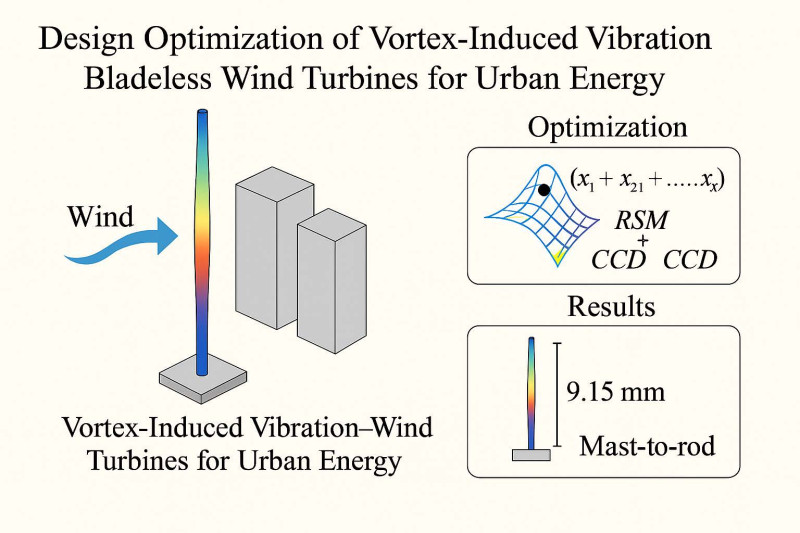
Design Optimization of Vortex-Induced Vibration Bladeless Wind Turbines for Urban Energy Harvesting
Abstract
Urban environments require innovative solutions for clean energy generation, as conventional wind turbines are often limited by space and noise constraints. Vortex-Induced Vibration (VIV) bladeless wind turbines present a promising alternative by converting oscillatory motion into electricity without rotating blades. This study investigates the influence of mast height, upper diameter, and lower diameter on turbine flexibility and performance under the low wind speeds typical of urban settings. Computational fluid dynamics and static structural analysis in ANSYS, combined with Response Surface Methodology (RSM) and Central Composite Design (CCD), were used to develop an optimization model aimed at maximizing mast deflection—a critical factor in energy harvesting efficiency. Results reveal that mast height and upper diameter significantly influence deformation, while lower diameter has a relatively minor impact. The optimal configuration achieved a mast deflection of 9.15 mm, validating the model’s predictive accuracy. These findings provide practical design insights for enhancing bladeless wind turbine performance in urban settings, paving the way for more sustainable and space-efficient renewable energy solutions.
Citation: Kwong, L., & Han, D. (2025). Design Optimization of Vortex-Induced Vibration Bladeless Wind Turbines for Urban Energy Harvesting. Trends in Renewable Energy, 11(2), 255-279. doi:http://dx.doi.org/10.17737/tre.2025.11.2.00194
Keywords
Full Text:
FULL TEXT (PDF)References
Dincer, I. (2000). Renewable energy and sustainable development: A crucial review. Renewable and sustainable energy reviews, 4(2), 157-175. doi:https://doi.org/10.1016/S1364-0321(99)00011-8
US EPA. (2025). What Is Green Power? https://www.epa.gov/green-power-markets/what-green-power (Accessed on 10/04/2025)
United Nations. (2025). THE 17 GOALS | Sustainable Development. https://sdgs.un.org/goals (Accessed on 10/04/2025)
US DOE. (2023). Renewable energy pillar. https://www.energy.gov/eere/renewable-energy-pillar (Accessed on 10/04/2025)
Tripathi, A., Thakur, S., & Aggarwal, T. (2023). Modal and Static Analysis of Vortex Bladeless Wind Turbines with Different Geometries. In E3S Web of Conferences (Vol. 430, p. 01254). EDP Sciences. doi:https://doi.org/10.1051/e3sconf/202343001254
Han, D., Huang, S., Hui, P. K. A., & Chen, Y. (2024). Development of a New Type of Vortex Bladeless Wind Turbine for Urban Energy Systems. In 2024 The 9th International Conference on Power and Renewable Energy (ICPRE) (pp. 973-978). IEEE. doi:https://doi.org/10.1109/ICPRE62586.2024.10768593
Francis, S., Umesh, V., & Shivakumar, S. (2021). Design and Analysis of Vortex Bladeless Wind Turbine. Materials Today: Proceedings, 47, 5584-5588. doi:https://doi.org/10.1016/j.matpr.2021.03.469
Adeyanju, A. A., & Boucher, D. (2020). Theoretical analysis of the bladeless wind turbine performance. Journal of Scientific Research and Reports, 26(10), 93-106. doi:https://doi.org/10.9734/jsrr/2020/v26i1030325
Kang, H., Kook, J., Lee, J., & Kim, Y. K. (2024). A novel small-scale bladeless wind turbine using vortex-induced vibration and a discrete resonance-shifting module. Applied Sciences, 14(18), 8217. doi:https://doi.org/10.3390/app14188217
Bond, P. (2021). Vortex Shedding 101: What is it & How Does it Affect Your Piping? https://www.piengineering.ca/blog/vortex-shedding-101/ (Accessed on 10/04/2025)
Villarreal, D. J. Y. (2018). VIV resonant wind generators. https://vortexbladeless.com/deliverables/VortexGreenPaper_en.pdf (Accessed on 10/04/2025)
Eldawy, R. S., Ghorab, A .A., & Sayed, M. M. (2024). A State-of-the-Art Review on Vortex Induced Vibrations Phenomenon Bladeless Wind Turbine Technology. Journal of Scientific Research and Reports, 30(11), 1045-1056. doi:https://doi.org/10.9734/jsrr/2024/v30i112631
Repsol. (2023). Bladeless wind turbines - The latest in wind energy. https://www.repsol.com/en/energy-move-forward/energy/bladeless-wind-turbines/index.cshtml (Accessed on 10/04/2025)
Seyed-Aghazadeh, B., Carlson, D. W., & Modarres-Sadeghi, Y. (2015). The influence of taper ratio on vortex-induced vibration of tapered cylinders in the crossflow direction. Journal of Fluids and Structures, 53, 84-95. doi:https://doi.org/10.1016/j.jfluidstructs.2014.07.014
Riva, R., Horcas, S. G., Sørensen, N. N., Grinderslev, C., & Pirrung, G. R. (2022). Stability analysis of vortex-induced vibrations on wind turbines. In Journal of Physics: Conference Series (Vol. 2265, No. 4, p. 042054). IOP Publishing. doi:https://doi.org/10.1088/1742-6596/2265/4/042054
Graciano, D. M., Sierra-Espinosa, F. Z., & García, J. C. (2024). Numerical simulation of vortex-induced vibration in a bladeless turbine: Effects of separation distance between tandem harvesters. Metascience in Aerospace, 1(3), 309-328. doi:https://doi.org/10.3934/mina.2024014
Mitra, E. D., & Hlavacek, W. S. (2019). Parameter estimation and uncertainty quantification for systems biology models. Current Opinion in Systems Biology, 18, 9-18. doi:https://doi.org/10.1016/j.coisb.2019.10.006
Tomar, V., Bansal, M., & Singh, P. (2024). Metaheuristic algorithms for optimization: A brief review. Engineering Proceedings, 59(1), 238. doi:https://doi.org/10.3390/engproc2023059238
Sun, H., Yang, H., & Tao, S. (2023). Optimization of the number, hub height and layout of offshore wind turbines. Journal of Marine Science and Engineering, 11(8), 1566. doi:https://doi.org/10.3390/jmse11081566
Thomas, J. J., Baker, N. F., Malisani, P., Quaeghebeur, E., Sanchez Perez-Moreno, S., Jasa, J., ... & Ning, A. (2023). A comparison of eight optimization methods applied to a wind farm layout optimization problem. Wind Energy Science, 8(5), 865-891. doi:https://doi.org/10.5194/wes-8-865-2023
Rezk, H., Olabi, A. G., Wilberforce, T., & Sayed, E. T. (2025). A multi-faceted review of wind turbine optimization techniques: Metaheuristics and related issues. International Journal of Thermofluids, 26, 101077. doi:https://doi.org/10.1016/j.ijft.2025.101077
Alnounou, M. A., & Samantaray, S. (2022). A numerical study to choose the best model for a bladeless wind turbine. In Recent Advances in Mechanical Engineering: Select Proceedings of ICRAMERD 2021 (pp. 359-369). Singapore: Springer Nature Singapore. doi:https://doi.org/10.1007/978-981-16-9057-0_38
Durakovic, B. (2017). Design of experiments application, concepts, examples: State of the art. Periodicals of Engineering and Natural Sciences, 5(3), 421-439. doi:https://doi.org/10.21533/pen.v5i3.145
DATA.GOV.HK. (2025). Daily mean wind speed - Daily Mean Wind Speed All Year - Central Pier. https://data.gov.hk/en-data/dataset/hk-hko-rss-daily-mean-wind-speed/resource/2c41f0f5-fc74-43be-ab6c-3b526acc6433 (Accessed on 10/04/2025)
Bridgestone Corporation. (2019). No blades! A pole-shaped wind turbine, Vortex Bladeless, generates power by shaking. https://www.bridgestone.com/bwsc/stories/article/2019/11/13-2.html (Accessed on 10/04/2025)
Al Saeed, S., Almasud, S., Alashwl, R., Aljameel, F., Alshahrani, S., & Alqahtani, M. (2024). Optimal Design of a Vortex Wind Turbine Using Taguchi Method. In Proceedings of 14th Annual International Conference on Industrial Engineering and Operations Management Dubai United Ara Emirates (UAE), pp: 1868-1881. doi:https://doi.org/10.46254/AN14.20240507
Mucci, T. (2024). Overfitting vs. underfitting: Finding the balance. https://www.ibm.com/think/topics/overfitting-vs-underfitting#:~:text=The%20rules,adaptable%20to%20the%20training%20data (Accessed on 10/04/2025)
Verma, M., & De, A. (2024). Flow dynamics of the transversely oscillating tapered circular cylinder under vortex-induced vibrations at low Reynolds number. Physics of Fluids, 36(10). doi:https://doi.org/10.1063/5.0231108
Guo, G., Zhong, S., Zhang, Q., Zhong, J., & Liu, D. (2023). Effect of additional mass on natural frequencies of weight-sensing structures. Sensors, 23(17), 7585. doi:https://doi.org/10.3390/s23177585
Han, D., & Panagou, D. (2019). Robust multi-task formation control via parametric Lyapunov-like barrier functions. IEEE Transactions on Automatic Control, 64(11), 4439-4453. doi:https://doi.org/10.1109/TAC.2019.2894587
Han, D., Chesi, G., & Hung, Y. S. (2013). Robust consensus for a class of uncertain multi-agent dynamical systems. IEEE Transactions on Industrial Informatics, 9(1), 306-312. doi:https://doi.org/10.1109/TII.2012.2222653
DOI: http://dx.doi.org/10.17737/tre.2025.11.2.00194
Refbacks
- There are currently no refbacks.
Copyright (c) 2025 Long Yin Kwong, Dongkun Han

This work is licensed under a Creative Commons Attribution 4.0 International License.
 This work is licensed under a Creative Commons Attribution 4.0 License.
Copyright @2014-2026 Trends in Renewable Energy (ISSN: 2376-2136, online ISSN: 2376-2144)